
Best Practice: Getting the Most from Psychology Tracking
Trandence’s psychological insights are only as powerful as the data you feed them. This guide walks you through the three habits that separate traders who use the platform from traders who master it.
1. Tag Your Emotional State Before Every Session
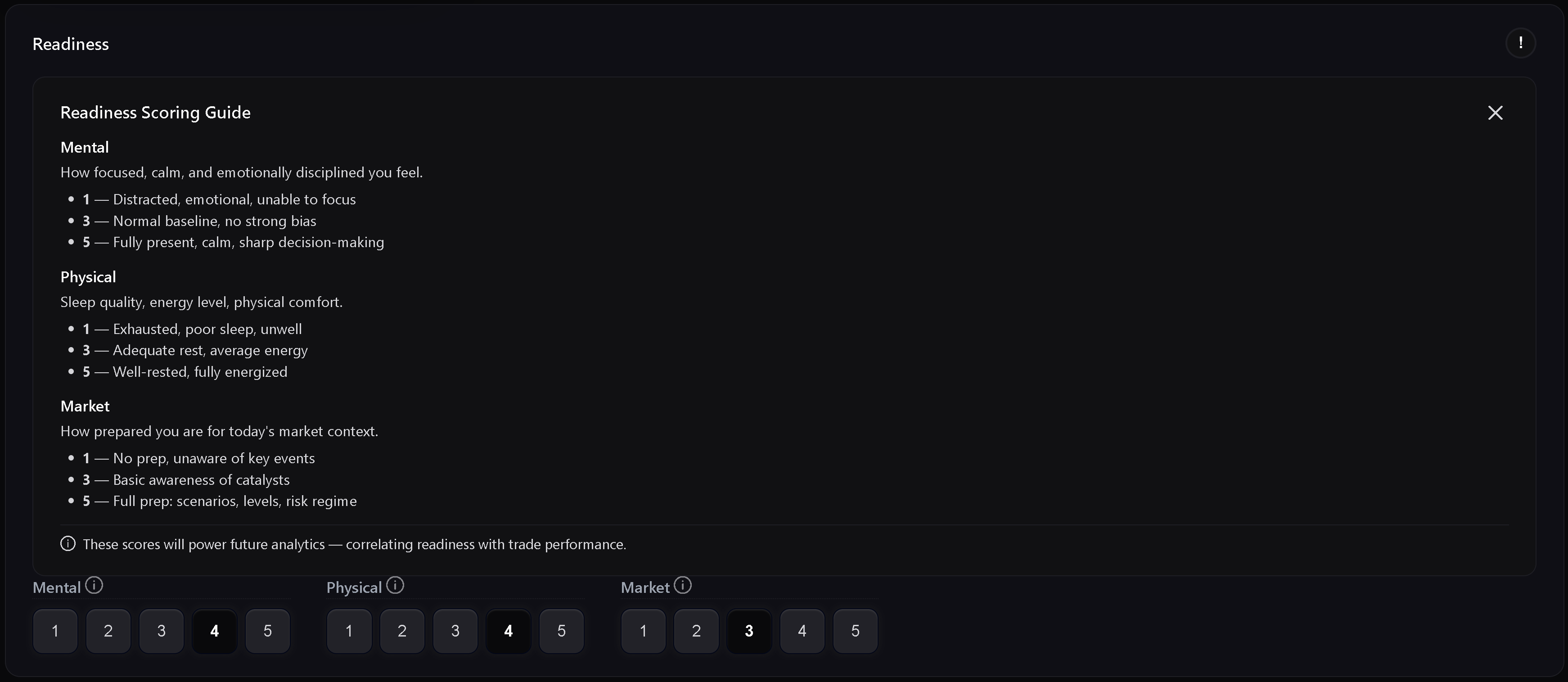
Before you deploy capital, take five seconds to select your current mood from the pre-session checklist. The available tags are:
- Focused — Clear-headed, well-rested, sharp decision-making capacity.
- Confident — Positive but controlled, trust in the process.
- Neutral — No strong emotional bias in either direction.
- Anxious — Elevated stress, heightened loss aversion.
- Tired — Cognitive fatigue, slower reaction time for entries.
- Frustrated — Residual emotion from prior losses, elevated revenge-trade risk.
These tags are qualitative inputs, but when aggregated over dozens of sessions, they become one of the most powerful analytical dimensions in your entire dataset. Thealgorithmic engine correlates each tag directly with your success rate and profitability, revealing patterns like: “Your success rate drops from 62% when Focused to 19% when Frustrated.”
The rule: If you skip the tag, the algorithmic engine cannot include that session in the correlation model. Consistency is everything.
2. Log Your Execution Mistakes — Honestly
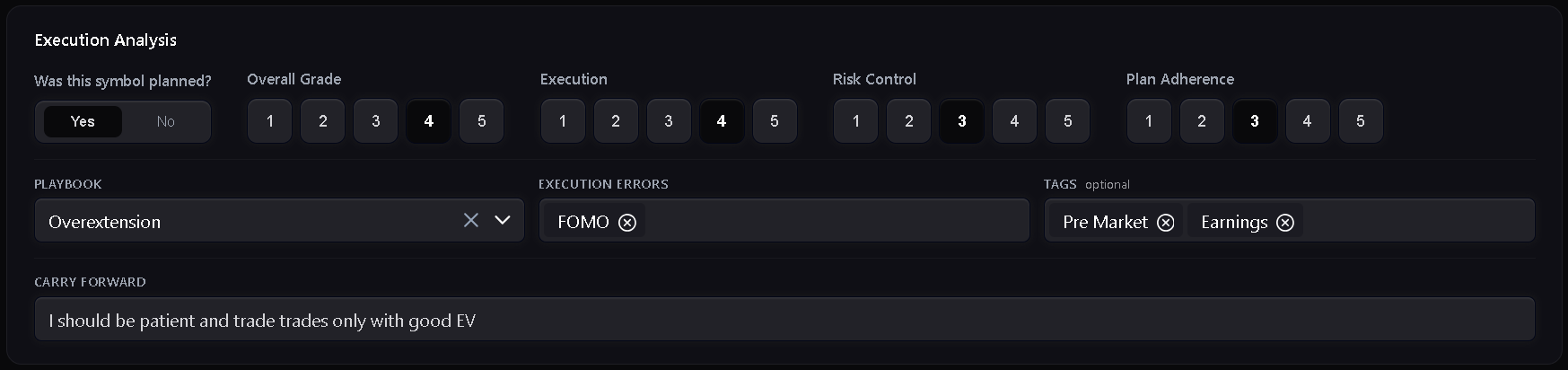
Be ruthlessly honest with yourself. When you make a mistake, log it in the trade’s notes or tags. Common mistakes to track include:
- Moved a stop loss — Widening your stop after the trade went against you instead of honoring the original level.
- Chased a runner — Entering a trade after the move already happened because of FOMO.
- Sized up after a loss — Classic revenge trading: doubling down to “make it back.”
- Took an off-plan trade — Executing a setup that wasn’t in any of your defined Playbooks.
- Ignored your Hard Stop — Continued trading after hitting your daily loss limit.
Thealgorithmic engine cannot coach you if the data is incomplete. A trade where you “forgot” to log a stop-loss move will look like a clean execution to the Data-Driven Risk Analyzer, and the system will fail to catch the pattern.
The rule: If you wouldn’t want an institutional mentor watching you do it, log it.
3. Review Your Weekly Discipline Score
Every week, check the Weekly Discipline Score on your main dashboard. This is your psychological trend line — it tracks:
- Emotional stability across sessions
- Playbook adherence consistency
- Risk rule compliance (honoring stops, sizing correctly)
- Tilt frequency (how often you enter the “Euphoria Cascade” or revenge-trade loops)
Think of it like a credit score for your execution discipline. A declining trend is an early warning that your process is slipping — even if your P&L is still green. As we explain in “Why Your Daily P&L is Lying to You,” green days with broken rules are the most dangerous kind.
The rule: If your Discipline Score drops for two consecutive weeks, reduce your position sizing by 50% until the trend reverses. Protect capital first, trade second.
Need Help?
If you have questions about configuring your emotional tags, understanding session grades, or interpreting your Weekly Discipline score, reach out to us at help@trandence.com — we’re ready to assist you.
Ready to Master Your Trading Psychology?
Join Trandence and let data-driven analytics detect tilt, enforce your playbook, and grade your execution — so you can trade with discipline.
Start Your Free Trial